Trash Bags
Pack Polymer Production Group, the largest producer of polymer products, has the capability to manufacture various products using polyethylene, polypropylene, and other raw materials. Trash bags are produced using polyethylene materials, and they vary in appearance and constituent raw materials.
For household use, we produce nylax trash bags with High-Density Polyethylene (HDPE) and a small amount of Low-Density Polyethylene (LDPE) to enhance elasticity and softness. For hospital and office use, we produce nylon trash bags with Low-Density Polyethylene.
Production and Sale of Trash Bags in Various Sizes and Thicknesses
Pack Polymer is capable of producing various types of trash bags in diverse dimensions and thicknesses according to customer orders.
Modern machinery and the expertise in producing flexible polymer products at Pack Polymer have led to the production of high-quality products at competitive prices.
Therefore, we can produce trash bags ranging from household trash bags with smaller dimensions and thicknesses to industrial and hospital trash bags with larger dimensions and thicknesses, based on customer needs.
Types of Trash Bags
Based on appearance, they include the following:
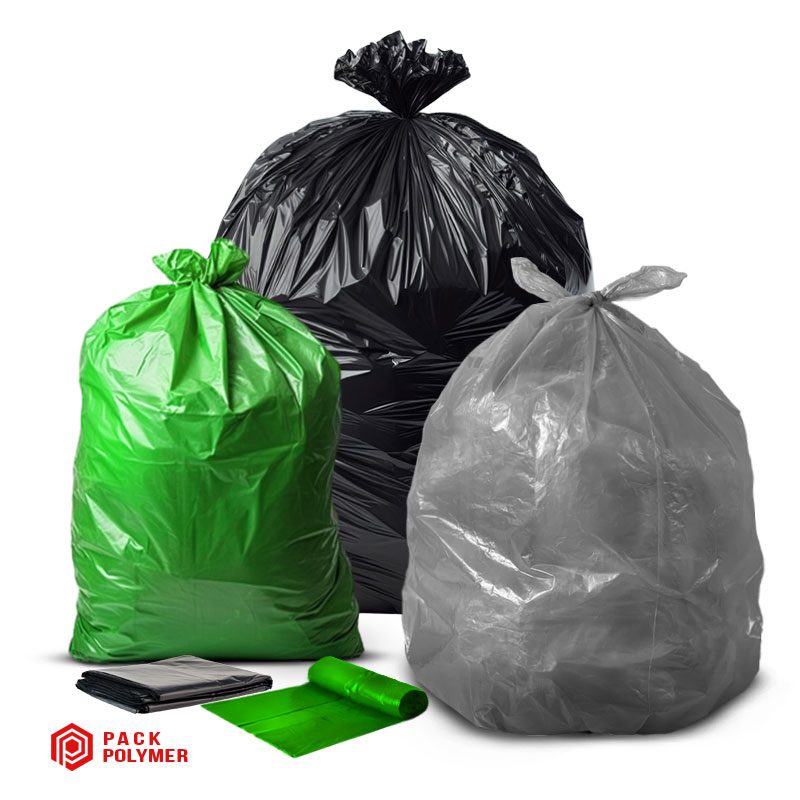
Perforated Roll Trash Bags: Produced in rolls with perforation lines for separating each bag.
Bulk ( by weight ) Trash Bags: Produced as individual sheets, folded and packed in sacks or cartons, weighing over 15 kg.
Sheeted ( Packaged ) Trash Bags: Produced as individual sheets, folded, and packed in boxes or plastic wraps, typically containing 10 to 20 sheets.
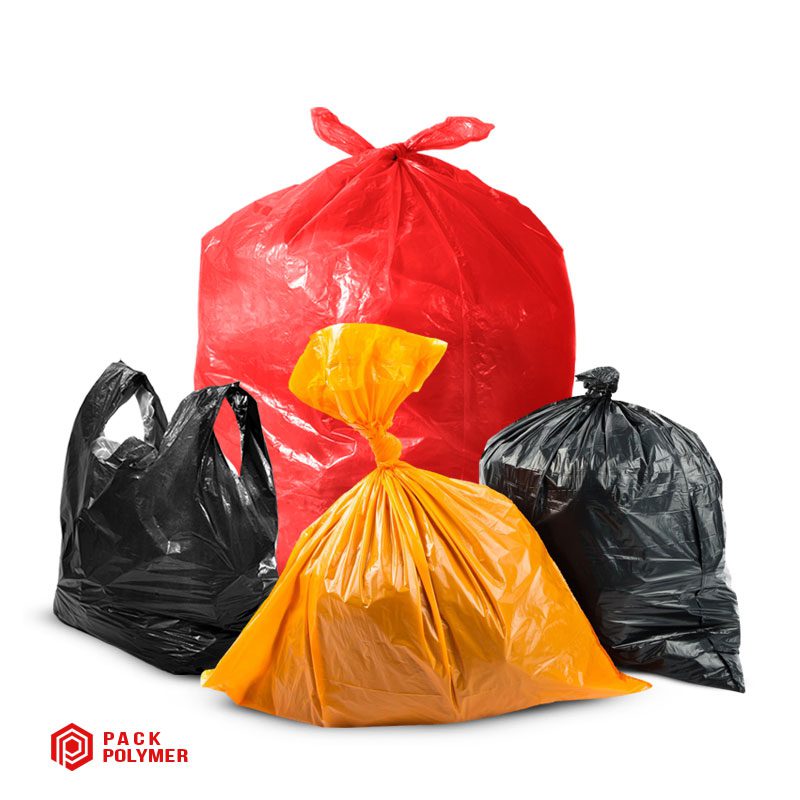
Drawstring Trash Bags: Trash bags produced with an added string at the opening for closing the bag.
Handle Trash Bags: Bags produced with handles for easier carrying of trash.
Types of Application and Material for Trash Bags
Hospital Trash Bags (PP, PE, LDPE)
Office and Public Center Trash Bags (Nylon)
Industrial Trash Bags (Nylon)
Household Trash Bags (Nylax)
Variety in Trash Bag Plastic Quality
The variety in quality based on raw materials is as follows:
Grade 1 Raw Materials: Materials produced and packaged in petrochemical plants, then imported into plastic manufacturing factories.
Grade 1.5 Raw Materials: These are recycled materials from the edges, handles, and excess trimmings of products initially made with Grade 1 petrochemical raw materials. These recycled materials are classified as Grade 1.5 and are of quality comparable to Grade 1.
Grade 2 Raw Materials: Grade 2 materials are obtained from recycling various plastic products that are then processed into granules.
Grade 3 Raw Materials: Materials derived from the recycling of Grade 2 materials.
Trash Bag Pricing
Several factors influence the pricing of trash bags. In addition to plastic quality, other factors affect the price:
Price of raw materials for trash bag production
Quality grade of the trash bag plastic
Modernity of machinery and the technical knowledge of the manufacturer
Biodegradable Trash Bags
Plastics play a significant role in people’s daily lives, from packaging and transporting goods to collecting waste.
Trash bags are produced in various models and qualities. By adding raw materials with specific properties, the final product gains those characteristics. One such additive for waste collection plastic production is biodegradable material, which enables the product to decompose in a very short time, causing minimal harm to the environment.
Therefore, in adherence to environmental principles, Pack Polymer has undertaken the production of biodegradable trash bags.
Colored Trash Bags
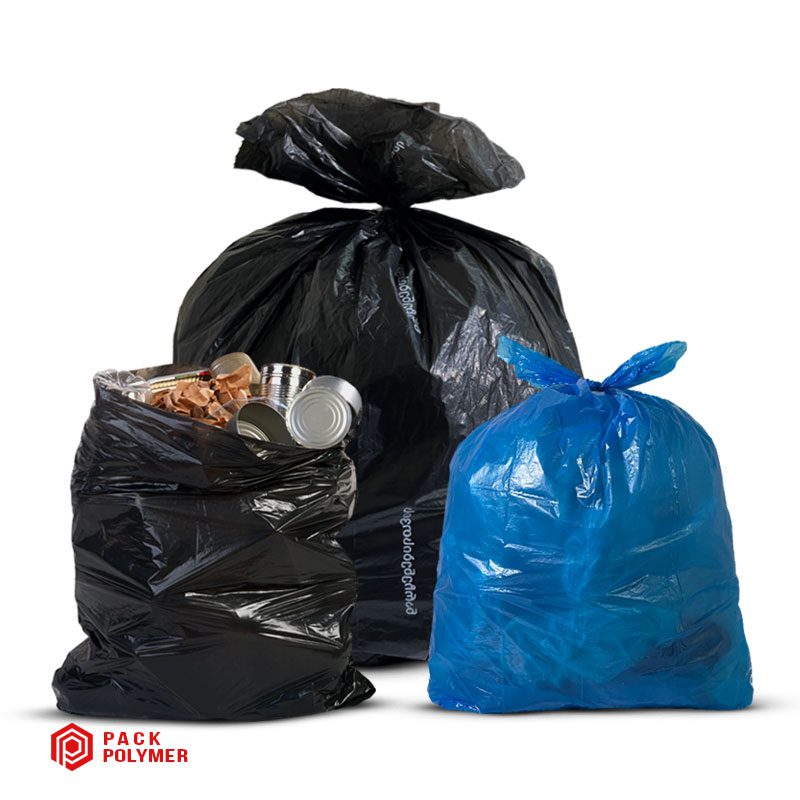
There are no limitations on the production of trash bags in various colors; the color of the plastic is determined solely by the consumer’s preference and choice.
To produce these colored products, the desired color masterbatch is added to the raw materials and mixed in a machine mixer, preparing the necessary materials. The desired color spectrum, ranging from light to dark shades, is achievable through the manufacturer’s knowledge, experience, and skill.
Therefore, if you have a bulk order for colored trash bags, be sure to consult with Pack Polymer’s experts to gain more information.
Printing on Trash Bags
To print on trash bags, after the nylon or nylax film is produced, the roll is mounted on a printing machine. With the machine’s settings adjusted and stencils accurately installed, the bags can be printed.
Generally, due to the low cost of this product and the fact that consumers intend to discard it daily, there isn’t much justification for the added cost of printing on trash bags.
However, for bags used for the disposal of infectious hospital waste, a biohazard print must be included on the plastic.
Consequently, printing is more commonly done on the outer wrap or packaging of the trash bag. In any case, if a customer wishes to use printed trash bags for advertising and branding their products, there are no obstacles.
Product Dimensions and Thickness
A wide variety of thicknesses and sizes are considered in the production of trash bags.
The thickness and dimensions of these bags are determined based on the weight, material, and volume of the contents to be placed inside the trash bag.
Pack Polymer is capable of producing all types of household, office, hospital, and other trash bags in various sizes and thicknesses, with no limitations in this regard, thanks to up-to-date knowledge and modern machinery.
Some of the advantages of this product include:
No need for heavy and costly frameworks.
Provides sufficient useful light for the growth of plants, saplings, and shrubs.
Reduces heating costs inside the greenhouse compared to other coverings.
Inexpensive and easily obtainable.
Minimizes the use of pesticides and insecticides.
Keeps plants safe from adverse weather conditions.
Maintains the temperature inside the greenhouse.
Prevents the penetration of harmful solar radiation.
Grading and Quality
If a customer requests inexpensive nylon, we are capable, based on our production knowledge, to use cheaper raw materials, generally recycled nylon, to reduce the price as per the customer’s request. Greenhouse film is produced in various quality grades, from Grade 1 to Grade 3, with competitive pricing for esteemed applicants and consumers.
Recycled nylon refers to a large volume of unprinted, high-purity nylons that are reprocessed into granular materials. These granular materials form the basis for the cheaper components of Grade 2 greenhouse film.
Single-Layer, 3-Layer, and 5-Layer Greenhouse Film
The production of such a product is carried out using single-layer and multi-layer machines. If greenhouse plastic is produced with a 2-layer or 3-layer machine, it will have greater strength and durability. Pack Polymer easily produces nylon using single-layer, 3-layer, and 5-layer machines. In a 3-layer nylon production machine, three separate cylinders and extruders feed the material. The raw materials are fed into each extruder, and each cylinder-extruder pair delivers the melted material to the film die. In this section, the die, the materials delivered from each extruder combine at the bottom of the die, and the combined layers impart greater strengthening properties to the nylon. The lamination of each plastic layer onto another enhances the strength of the final product. Remember, when the number of layers increases, it does not necessarily mean the nylon becomes thicker; the thickness of the nylon is determined by the machine operator.
The 5-layer greenhouse film production machine at Pack Polymer is equipped with the most advanced capabilities to enhance the properties, strength, and lifespan of the nylon, ready to meet the needs of export and domestic markets.
Greenhouse Plastic Pricing
Greenhouse plastics can be produced in various widths and thicknesses. It’s important to note that the thickness or width of this plastic does not affect the price of greenhouse plastic, as we sell greenhouse plastic by weight. Furthermore, if the greenhouse plastic is produced using a single-layer or multi-layer machine, there will be a difference in quality in terms of strength. It should not be forgotten that regardless of whether greenhouse plastic is produced with single-layer or multi-layer machines, the quality of the raw materials remains the same. Only the type of machine affects the strength of the produced product. Greenhouse plastic and agricultural plastic produced with a multi-layer machine have higher strength compared to plastic produced with a single-layer machine.
Thickness of These Types of Plastics
Greenhouse plastics are produced according to the customers’ desired thickness. Pack Polymer Group has the capability to produce greenhouse plastic from 100 to 350 microns in thickness. Additionally, production in various widths, from one meter to 20 meters, can be implemented by Pack Polymer upon customer order. Generally, wide plastics with various thicknesses are used, but the commonly used thickness for greenhouse plastic is 200 microns and above.
“Nylon 020” means 200 microns in thickness, and “015” means 150 microns. Therefore, to measure the thickness of the nylon, standard and precise micrometers should be used to determine the actual thickness of this product for buyers.
Production of UV-Treated Nylon (UV)
If the customer wishes to use UV-treated nylon for their greenhouse covering or agricultural purposes, Pack Polymer is capable of producing wide UV-treated nylon with higher durability against sunlight. UV-treated nylon has higher strength against sunlight compared to ordinary nylon, and the UV additives, which play a crucial role in the raw material composition for producing greenhouse plastic, are a significant feature.
Color Range of Wide Nylon
Due to its transparency, this product allows sunlight to pass through. Since greenhouse crops, vegetables, and fruits require sunlight, transparent greenhouse plastic facilitates this.
It is worth mentioning that greenhouse plastics can be produced in various colors. An excessive or dark amount of color can prevent sunlight from passing through easily. However, farmers and greenhouse owners use various colors with light-transmitting capabilities based on their needs, preferences, or strategies. Additionally, in regions with very high solar radiation, UV additives in greenhouse plastic can prevent the harmful effects of UV rays in sunlight, thus protecting the greenhouse products from damage, and also increasing the strength of the nylon.
Raw Material Additives for Greenhouse Plastic
Color Masterbatch: (For custom-colored nylon production in customer-required colors)
Anti-UV: Used to prevent damage from sunlight to the plants inside the greenhouse and also to strengthen the nylon material. This is known as anti-UV wide nylon.
Anti-Fog: Used to prevent condensation on the nylon due to greenhouse temperature fluctuations. With these anti-fog materials, appropriate light penetrates the greenhouse, and excess moisture is removed. This is called anti-fog wide greenhouse nylon.
Anti-Dust: Significantly effective in preventing dust from settling on the nylon and also on the plants inside the greenhouse.
Anti-Static: Also known as anti-static electricity.
Anti-IR: Used to prevent the adverse effects of infrared radiation on plants and also for greenhouse plastic.
Other Additives
Greenhouse and Agricultural Plastic
Flexible plastics hold a special place in human life, and with each passing day, the scope of use for these attractive and unique products expands. Among these applications is in the field of agriculture, where a wide variety of these products can be observed. One manifestation of modern agriculture is the cultivation of plants, vegetables, fruits, and produce in greenhouses, which offers numerous advantages due to the mechanization of agricultural activities.
The plastics used in this sector are produced from light polyethylene (LDPE) raw materials and have brought special advantages to farmers. The various types of plastics that contribute to added value, reduced costs of planting, cultivation, and harvesting, as well as increased productivity in this vital area, are as follows:
Greenhouse plastic (UV-treated and standard in various widths and lengths)
Forage packaging plastic (Silage Stretch)
Rice nursery plastic (for seedling cultivation)
Mulch plastic (optimization of irrigation, fertilization, plant maintenance, etc.)
Wide plastic (from 1 to 20 meters in width)
Seedling planting plastic
Types of Greenhouse Plastic
Pack Polymer is one of the largest producers of UV-treated and standard greenhouse plastics. Utilizing diverse and advanced machinery for single-layer to 5-layer wide plastic production, they guarantee the best quality and the cheapest prices to their customers. Greenhouse and agricultural plastic, as its name suggests, has extensive applications in agriculture and horticulture. When a greenhouse is established, this product is one of the most important and essential items required for its construction. Due to its affordability and ease of procurement and purchase, this product is in high demand in both export and domestic markets. This valuable product is manufactured using polyethylene raw materials, and the knowledge of combining these materials creates a competitive advantage and a value proposition in terms of price and quality.
Features of Greenhouse Plastic
After the metal framework of greenhouses is constructed, these plastics are used to cover the side walls and roof. The Pack Polymer production and supply group offers customers the best and highest quality greenhouse and agricultural plastic. Greenhouse plastics, due to their transparency, allow sunlight to pass through for the growth of plants, fruits, vegetables, and all botanical products inside the greenhouse. To prevent the disadvantages and damages of solar radiation (ultraviolet radiation), by adding a specific percentage of Anti-UV materials to the raw material composition during production, these adverse effects can be mitigated, thus maintaining its status as the best and most affordable greenhouse covering.
Characteristics of These Types of Plastics
One of the most important characteristics that greenhouse plastic should possess is desirable elasticity, lack of dryness, and high flexibility to prevent tearing, puncturing, or fragmentation. For this reason, Pack Polymer uses only high-quality raw materials to provide the best quality in its Grade 1 plastic production.
Some of the advantages of this product include:
No need for heavy and expensive frameworks
Providing beneficial light for the growth of plants, seedlings, and saplings
Reducing heating costs inside the greenhouse compared to other coverings
Affordable price and easy availability
Minimizing the use of pesticides and insecticides
Protecting plants from adverse weather conditions
Maintaining the temperature inside the greenhouse
Preventing the penetration of harmful solar radiation
Grading and Quality
If a customer requests inexpensive plastic, we are capable of utilizing cheaper raw materials, generally recycled plastics, to reduce the price, based on the customer’s request and our production knowledge. Greenhouse plastic is produced in various quality grades, from Grade 1 to Grade 3, at competitive prices for esteemed applicants and consumers.
Recycled plastic refers to a process where a large volume of unprinted, high-purity plastics are reprocessed into granular materials. These granular materials then form the basis for cheaper materials used in Grade 2 greenhouse plastic.
Single-layer, 3-layer, and 5-layer greenhouse plastic.
The production of such a product is carried out using single-layer and multi-layer machines. If greenhouse plastic is produced with a 2-layer or 3-layer machine, it will have higher power and strength. The production of nylon with single-layer, 3-layer, and 5-layer machines is easily done at Pack Polymer Group. In three-layer nylon production machines, three separate cylinders and extruders feed the material. This means the raw materials enter each extruder, and each cylinder-extruder pair delivers the melted material to the nylon production machine’s die. At this point, in the machine’s die, the materials delivered from each extruder combine at the bottom of the die, and the combined layers provide greater strengthening properties to the nylon. Laminating each plastic layer onto another layer will enhance the strength of the final product. Remember, when the number of layers increases, it doesn’t necessarily mean the nylon gets thicker; the thickness of the nylon is determined by the machine operator.
The 5-layer greenhouse nylon production machine, with its maximum capabilities for enhancing the properties, strength, and lifespan of the nylon, is available at Pack Polymer to meet export and domestic market needs.
Greenhouse Plastic Pricing
Greenhouse plastics can be produced in various widths and thicknesses. It’s important to note that the thickness or width of this plastic does not affect the price of greenhouse plastic, as we sell greenhouse plastic by weight. Furthermore, if the greenhouse plastic is produced using a single-layer or multi-layer machine, there will be a difference in quality in terms of strength. It should not be forgotten that regardless of whether greenhouse plastic is produced with single-layer or multi-layer machines, the quality of the raw materials remains the same. Only the type of machine affects the strength of the produced product. If greenhouse plastic and agricultural plastic are produced with a multi-layer machine, they have higher strength compared to plastic produced with a single-layer machine.
Thickness of These Types of Plastics
Greenhouse plastics are produced according to the customers’ desired thickness. Pack Polymer Group has the capability to produce greenhouse plastic from 100 to 350 microns in thickness. Additionally, production in various widths, from one meter to 20 meters, can be implemented by Pack Polymer upon customer order. Generally, wide plastics with various thicknesses are used, but the commonly used thickness for greenhouse plastic is 200 microns and above.
“Nylon 020” means 200 microns in thickness, and “015” means 150 microns. Therefore, to measure the thickness of the nylon, standard and precise micrometers should be used to determine the actual thickness of this product for buyers.
Production of UV-Treated Nylon (UV)
If the customer wishes to use UV-treated nylon for their greenhouse covering or agricultural purposes, Pack Polymer is capable of producing wide UV-treated nylon with higher durability against sunlight. UV-treated nylon has higher strength against sunlight compared to ordinary nylon, and the UV additives, which play a crucial role in the raw material composition for producing greenhouse plastic, are a significant feature.
Color Range of Wide Nylon
Due to its transparency, this product allows sunlight to pass through. Since greenhouse crops, vegetables, and fruits require sunlight, transparent greenhouse plastic facilitates this.
It is worth mentioning that greenhouse plastics can be produced in various colors. An excessive or dark amount of color can prevent sunlight from passing through easily. However, farmers and greenhouse owners use various colors with light-transmitting capabilities based on their needs, preferences, or strategies. Additionally, in regions with very high solar radiation, UV additives in greenhouse plastic can prevent the harmful effects of UV rays in sunlight, thus protecting the greenhouse products from damage, and also increasing the strength of the nylon.
Raw Material Additives for Greenhouse Plastic
Color Masterbatch: (For custom-colored nylon production in customer-required colors)
Anti-UV: Used to prevent damage from sunlight to the plants inside the greenhouse and also to strengthen the nylon material. This is known as anti-UV wide nylon.
Anti-Fog: Used to prevent condensation on the nylon due to greenhouse temperature fluctuations. With these anti-fog materials, appropriate light penetrates the greenhouse, and excess moisture is removed. This is called anti-fog wide greenhouse nylon.
Anti-Dust: Significantly effective in preventing dust from settling on the nylon and also on the plants inside the greenhouse.
Anti-Static: Also known as anti-static electricity.
Anti-IR: Used to prevent the adverse effects of infrared radiation on plants and also for greenhouse plastic.
Other Additives
The text highlights the significant and growing role of flexible plastics, particularly in agriculture, with a focus on greenhouse applications. Greenhouse plastics are made from light polyethylene (LDPE) and offer numerous benefits to farmers, including increased added value, reduced costs, and improved productivity.
The document lists various agricultural plastic products offered by Pack Polymer, such as:
Greenhouse plastic (UV-treated and standard, in various widths and lengths)
Silage stretch film for forage packaging
Rice nursery plastic
Mulch plastic (for optimizing irrigation, fertilization, and plant care)
Wide plastic sheeting (1 to 20 meters wide)
Seedling planting plastic
Pack Polymer is presented as a major producer of greenhouse plastics, utilizing advanced single-layer to 5-layer machines to ensure high quality and competitive pricing. The text emphasizes that greenhouse plastic is a crucial and readily available material for constructing greenhouses, making it popular in both domestic and export markets. The company’s expertise in combining raw materials provides a competitive edge in quality and price.
Key features and benefits of greenhouse plastic are detailed:
Functionality: Used to cover the walls and roofs of greenhouses after the frame is built.
Light Transmission: Its transparency allows essential sunlight for plant growth.
UV Protection: UV-treated versions incorporate anti-UV additives to protect plants from damaging ultraviolet radiation, enhancing the plastic’s durability.
Material Properties: Desirable elasticity, flexibility, and resistance to dryness are crucial to prevent tearing. Pack Polymer uses high-quality raw materials for its Grade 1 products.
The advantages of using greenhouse plastic include:
Eliminating the need for heavy, expensive frameworks.
Providing sufficient light for plant growth.
Reducing greenhouse heating costs.
Affordability and easy availability.
Minimizing the need for pesticides.
Protecting plants from adverse weather conditions.
Maintaining stable greenhouse temperatures.
Blocking harmful solar radiation.
Grading and Quality:
Cost Reduction: If a customer requests cheaper nylon, Pack Polymer can use less expensive raw materials, primarily recycled nylon, to reduce the price.
Quality Grades: Greenhouse nylon is produced in various quality grades (1 to 3) with competitive pricing.
Recycled Nylon: This refers to high-purity, unprinted nylons that are reprocessed into granules. These granules form the basis for the less expensive Grade 2 greenhouse nylon.
Single-Layer, 3-Layer, and 5-Layer Greenhouse Nylon:
Production: This type of product is manufactured using single-layer and multi-layer machines.
Multi-Layer Advantage: Plastics produced with 2-layer or 3-layer machines have higher strength and durability. Pack Polymer easily produces nylon with single-layer, 3-layer, and 5-layer machines.
3-Layer Machine Process: In a 3-layer machine, three separate cylinders and extruders feed the material. Each cylinder-extruder pair melts the raw material and delivers it to the machine’s die. At the die, the materials from each extruder combine, forming laminated layers that significantly enhance the nylon’s strength. Laminating each plastic layer onto another increases the final product’s robustness.
Layer Count vs. Thickness: An increase in the number of layers does not automatically mean the nylon becomes thicker. The thickness is determined by the machine operator.
5-Layer Machine Capability: Pack Polymer’s 5-layer greenhouse nylon production machine is equipped with advanced features to maximize the nylon’s properties, strength, and lifespan, catering to both export and domestic markets.
Greenhouse Plastic Pricing:
Pricing Basis: Greenhouse plastic is sold by weight, meaning the thickness or width does not directly impact the price.
Quality vs. Machine Type: While the quality of raw materials is consistent, the type of machine used (single-layer vs. multi-layer) affects the final product’s strength. Multi-layer machines produce stronger agricultural and greenhouse plastics compared to single-layer ones.
Nylon Thickness:
Customization: Greenhouse plastic is produced according to customer-specified thicknesses.
Range: Pack Polymer can produce greenhouse plastic from 100 to 350 microns in thickness.
Width: Production in various widths, from 1 to 20 meters, is also available upon customer order.
Common Thickness: While various thicknesses are used, 200 microns and above is the most common for greenhouse nylon.
Micron Standards: “Nylon 020” refers to 200 microns, and “015” refers to 150 microns. Standard and precise micrometers should be used to measure the actual thickness accurately.
UV-Treated Nylon (UV) Production:
Enhanced Durability: If a customer requires UV-treated nylon for greenhouse covering or agricultural use, Pack Polymer can produce wide UV-treated nylon with higher resistance to sunlight.
UV Additives: UV-treated nylon offers superior strength against sunlight compared to regular nylon. The UV additives, a key component in the raw material mix for greenhouse plastic, provide this significant advantage.
Coloring of Wide Nylon:
Transparency is Key: The primary function of greenhouse plastic is its transparency, allowing sunlight necessary for the growth of crops, vegetables, and fruits.
Custom Colors: While clear plastic is standard, greenhouse plastic can be produced in various colors.
Color Impact: Highly saturated or dark colors can impede sunlight penetration. However, farmers may choose specific colors based on their needs, preferences, or strategies, ensuring sufficient light transmission.
UV Protection in High-Sunlight Areas: In regions with intense sunlight, UV additives in the greenhouse plastic are crucial. They prevent UV damage to plants and increase the plastic’s overall strength.
Additive Masterbatches for Greenhouse Plastic:
The text lists several important additive masterbatches that can be incorporated into greenhouse plastic:
Color Masterbatch: Used to customize the nylon’s color according to customer requirements.
Anti-UV (Anti-UV):
Protects plants inside the greenhouse from sun damage.
Enhances the nylon’s durability.
Nylon incorporating this additive is referred to as “Anti-UV Wide Nylon.”
Anti-Fog (Anti-Fog):
Prevents condensation (sweating) inside the greenhouse caused by temperature fluctuations.
Allows adequate light to penetrate the greenhouse.
Removes excess moisture.
Nylon with this additive is called “Anti-Fog Wide and Greenhouse Nylon.”
Anti-Dust (Anti-Dust):
Significantly reduces the settling of dust on the nylon and the plants within the greenhouse.
Anti-Static (Anti-Static):
Also known as “anti-static electricity,” it prevents the build-up of static charges.
Anti-IR (Anti-IR):
Protects plants from the effects of infrared radiation.
Also beneficial for the greenhouse plastic itself.
Other Additives
Trash Bags
Pack Polymer Production Group, the largest producer of polymer products, has the capability to manufacture various products using polyethylene, polypropylene, and other raw materials. Trash bags are produced using polyethylene materials, and they vary in appearance and constituent raw materials.
For household use, we produce nylax trash bags with High-Density Polyethylene (HDPE) and a small amount of Low-Density Polyethylene (LDPE) to enhance elasticity and softness. For hospital and office use, we produce nylon trash bags with Low-Density Polyethylene.
Production and Sale of Trash Bags in Various Sizes and Thicknesses
Pack Polymer is capable of producing various types of trash bags in diverse dimensions and thicknesses according to customer orders.
Modern machinery and the expertise in producing flexible polymer products at Pack Polymer have led to the production of high-quality products at competitive prices.
Therefore, we can produce trash bags ranging from household trash bags with smaller dimensions and thicknesses to industrial and hospital trash bags with larger dimensions and thicknesses, based on customer needs.
Types of Trash Bags
Based on appearance, they include the following:
Perforated Roll Trash Bags: Produced in rolls with perforation lines for separating each bag.
Bulk ( by weight ) Trash Bags: Produced as individual sheets, folded and packed in sacks or cartons, weighing over 15 kg.
Sheeted ( Packaged ) Trash Bags: Produced as individual sheets, folded, and packed in boxes or plastic wraps, typically containing 10 to 20 sheets.
Drawstring Trash Bags: Trash bags produced with an added string at the opening for closing the bag.
Handle Trash Bags: Bags produced with handles for easier carrying of trash.
Types of Application and Material for Trash Bags
Hospital Trash Bags (PP, PE, LDPE)
Office and Public Center Trash Bags (Nylon)
Industrial Trash Bags (Nylon)
Household Trash Bags (Nylax)
Variety in Trash Bag Plastic Quality
The variety in quality based on raw materials is as follows:
Grade 1 Raw Materials: Materials produced and packaged in petrochemical plants, then imported into plastic manufacturing factories.
Grade 1.5 Raw Materials: These are recycled materials from the edges, handles, and excess trimmings of products initially made with Grade 1 petrochemical raw materials. These recycled materials are classified as Grade 1.5 and are of quality comparable to Grade 1.
Grade 2 Raw Materials: Grade 2 materials are obtained from recycling various plastic products that are then processed into granules.
Grade 3 Raw Materials: Materials derived from the recycling of Grade 2 materials.
Trash Bag Pricing
Several factors influence the pricing of trash bags. In addition to plastic quality, other factors affect the price:
Price of raw materials for trash bag production
Quality grade of the trash bag plastic
Modernity of machinery and the technical knowledge of the manufacturer
Biodegradable Trash Bags
Plastics play a significant role in people’s daily lives, from packaging and transporting goods to collecting waste.
Trash bags are produced in various models and qualities. By adding raw materials with specific properties, the final product gains those characteristics. One such additive for waste collection plastic production is biodegradable material, which enables the product to decompose in a very short time, causing minimal harm to the environment.
Therefore, in adherence to environmental principles, Pack Polymer has undertaken the production of biodegradable trash bags.
Colored Trash Bags
There are no limitations on the production of trash bags in various colors; the color of the plastic is determined solely by the consumer’s preference and choice.
To produce these colored products, the desired color masterbatch is added to the raw materials and mixed in a machine mixer, preparing the necessary materials. The desired color spectrum, ranging from light to dark shades, is achievable through the manufacturer’s knowledge, experience, and skill.
Therefore, if you have a bulk order for colored trash bags, be sure to consult with Pack Polymer’s experts to gain more information.
Printing on Trash Bags
To print on trash bags, after the nylon or nylax film is produced, the roll is mounted on a printing machine. With the machine’s settings adjusted and stencils accurately installed, the bags can be printed.
Generally, due to the low cost of this product and the fact that consumers intend to discard it daily, there isn’t much justification for the added cost of printing on trash bags.
However, for bags used for the disposal of infectious hospital waste, a biohazard print must be included on the plastic.
Consequently, printing is more commonly done on the outer wrap or packaging of the trash bag. In any case, if a customer wishes to use printed trash bags for advertising and branding their products, there are no obstacles.
Product Dimensions and Thickness
A wide variety of thicknesses and sizes are considered in the production of trash bags.
The thickness and dimensions of these bags are determined based on the weight, material, and volume of the contents to be placed inside the trash bag.
Pack Polymer is capable of producing all types of household, office, hospital, and other trash bags in various sizes and thicknesses, with no limitations in this regard, thanks to up-to-date knowledge and modern machinery.
Some of the advantages of this product include:
No need for heavy and costly frameworks.
Provides sufficient useful light for the growth of plants, saplings, and shrubs.
Reduces heating costs inside the greenhouse compared to other coverings.
Inexpensive and easily obtainable.
Minimizes the use of pesticides and insecticides.
Keeps plants safe from adverse weather conditions.
Maintains the temperature inside the greenhouse.
Prevents the penetration of harmful solar radiation.
Grading and Quality
If a customer requests inexpensive nylon, we are capable, based on our production knowledge, to use cheaper raw materials, generally recycled nylon, to reduce the price as per the customer’s request. Greenhouse film is produced in various quality grades, from Grade 1 to Grade 3, with competitive pricing for esteemed applicants and consumers.
Recycled nylon refers to a large volume of unprinted, high-purity nylons that are reprocessed into granular materials. These granular materials form the basis for the cheaper components of Grade 2 greenhouse film.
Single-Layer, 3-Layer, and 5-Layer Greenhouse Film
The production of such a product is carried out using single-layer and multi-layer machines. If greenhouse plastic is produced with a 2-layer or 3-layer machine, it will have greater strength and durability. Pack Polymer easily produces nylon using single-layer, 3-layer, and 5-layer machines. In a 3-layer nylon production machine, three separate cylinders and extruders feed the material. The raw materials are fed into each extruder, and each cylinder-extruder pair delivers the melted material to the film die. In this section, the die, the materials delivered from each extruder combine at the bottom of the die, and the combined layers impart greater strengthening properties to the nylon. The lamination of each plastic layer onto another enhances the strength of the final product. Remember, when the number of layers increases, it does not necessarily mean the nylon becomes thicker; the thickness of the nylon is determined by the machine operator.
The 5-layer greenhouse film production machine at Pack Polymer is equipped with the most advanced capabilities to enhance the properties, strength, and lifespan of the nylon, ready to meet the needs of export and domestic markets.
Greenhouse Plastic Pricing
Greenhouse plastics can be produced in various widths and thicknesses. It’s important to note that the thickness or width of this plastic does not affect the price of greenhouse plastic, as we sell greenhouse plastic by weight. Furthermore, if the greenhouse plastic is produced using a single-layer or multi-layer machine, there will be a difference in quality in terms of strength. It should not be forgotten that regardless of whether greenhouse plastic is produced with single-layer or multi-layer machines, the quality of the raw materials remains the same. Only the type of machine affects the strength of the produced product. Greenhouse plastic and agricultural plastic produced with a multi-layer machine have higher strength compared to plastic produced with a single-layer machine.
Thickness of These Types of Plastics
Greenhouse plastics are produced according to the customers’ desired thickness. Pack Polymer Group has the capability to produce greenhouse plastic from 100 to 350 microns in thickness. Additionally, production in various widths, from one meter to 20 meters, can be implemented by Pack Polymer upon customer order. Generally, wide plastics with various thicknesses are used, but the commonly used thickness for greenhouse plastic is 200 microns and above.
“Nylon 020” means 200 microns in thickness, and “015” means 150 microns. Therefore, to measure the thickness of the nylon, standard and precise micrometers should be used to determine the actual thickness of this product for buyers.
Production of UV-Treated Nylon (UV)
If the customer wishes to use UV-treated nylon for their greenhouse covering or agricultural purposes, Pack Polymer is capable of producing wide UV-treated nylon with higher durability against sunlight. UV-treated nylon has higher strength against sunlight compared to ordinary nylon, and the UV additives, which play a crucial role in the raw material composition for producing greenhouse plastic, are a significant feature.
Color Range of Wide Nylon
Due to its transparency, this product allows sunlight to pass through. Since greenhouse crops, vegetables, and fruits require sunlight, transparent greenhouse plastic facilitates this.
It is worth mentioning that greenhouse plastics can be produced in various colors. An excessive or dark amount of color can prevent sunlight from passing through easily. However, farmers and greenhouse owners use various colors with light-transmitting capabilities based on their needs, preferences, or strategies. Additionally, in regions with very high solar radiation, UV additives in greenhouse plastic can prevent the harmful effects of UV rays in sunlight, thus protecting the greenhouse products from damage, and also increasing the strength of the nylon.
Raw Material Additives for Greenhouse Plastic
Color Masterbatch: (For custom-colored nylon production in customer-required colors)
Anti-UV: Used to prevent damage from sunlight to the plants inside the greenhouse and also to strengthen the nylon material. This is known as anti-UV wide nylon.
Anti-Fog: Used to prevent condensation on the nylon due to greenhouse temperature fluctuations. With these anti-fog materials, appropriate light penetrates the greenhouse, and excess moisture is removed. This is called anti-fog wide greenhouse nylon.
Anti-Dust: Significantly effective in preventing dust from settling on the nylon and also on the plants inside the greenhouse.
Anti-Static: Also known as anti-static electricity.
Anti-IR: Used to prevent the adverse effects of infrared radiation on plants and also for greenhouse plastic.
Other Additives
Greenhouse and Agricultural Plastic
Flexible plastics hold a special place in human life, and with each passing day, the scope of use for these attractive and unique products expands. Among these applications is in the field of agriculture, where a wide variety of these products can be observed. One manifestation of modern agriculture is the cultivation of plants, vegetables, fruits, and produce in greenhouses, which offers numerous advantages due to the mechanization of agricultural activities.
The plastics used in this sector are produced from light polyethylene (LDPE) raw materials and have brought special advantages to farmers. The various types of plastics that contribute to added value, reduced costs of planting, cultivation, and harvesting, as well as increased productivity in this vital area, are as follows:
Greenhouse plastic (UV-treated and standard in various widths and lengths)
Forage packaging plastic (Silage Stretch)
Rice nursery plastic (for seedling cultivation)
Mulch plastic (optimization of irrigation, fertilization, plant maintenance, etc.)
Wide plastic (from 1 to 20 meters in width)
Seedling planting plastic
Types of Greenhouse Plastic
Pack Polymer is one of the largest producers of UV-treated and standard greenhouse plastics. Utilizing diverse and advanced machinery for single-layer to 5-layer wide plastic production, they guarantee the best quality and the cheapest prices to their customers. Greenhouse and agricultural plastic, as its name suggests, has extensive applications in agriculture and horticulture. When a greenhouse is established, this product is one of the most important and essential items required for its construction. Due to its affordability and ease of procurement and purchase, this product is in high demand in both export and domestic markets. This valuable product is manufactured using polyethylene raw materials, and the knowledge of combining these materials creates a competitive advantage and a value proposition in terms of price and quality.
Features of Greenhouse Plastic
After the metal framework of greenhouses is constructed, these plastics are used to cover the side walls and roof. The Pack Polymer production and supply group offers customers the best and highest quality greenhouse and agricultural plastic. Greenhouse plastics, due to their transparency, allow sunlight to pass through for the growth of plants, fruits, vegetables, and all botanical products inside the greenhouse. To prevent the disadvantages and damages of solar radiation (ultraviolet radiation), by adding a specific percentage of Anti-UV materials to the raw material composition during production, these adverse effects can be mitigated, thus maintaining its status as the best and most affordable greenhouse covering.
Characteristics of These Types of Plastics
One of the most important characteristics that greenhouse plastic should possess is desirable elasticity, lack of dryness, and high flexibility to prevent tearing, puncturing, or fragmentation. For this reason, Pack Polymer uses only high-quality raw materials to provide the best quality in its Grade 1 plastic production.
Some of the advantages of this product include:
No need for heavy and expensive frameworks
Providing beneficial light for the growth of plants, seedlings, and saplings
Reducing heating costs inside the greenhouse compared to other coverings
Affordable price and easy availability
Minimizing the use of pesticides and insecticides
Protecting plants from adverse weather conditions
Maintaining the temperature inside the greenhouse
Preventing the penetration of harmful solar radiation
Grading and Quality
If a customer requests inexpensive plastic, we are capable of utilizing cheaper raw materials, generally recycled plastics, to reduce the price, based on the customer’s request and our production knowledge. Greenhouse plastic is produced in various quality grades, from Grade 1 to Grade 3, at competitive prices for esteemed applicants and consumers.
Recycled plastic refers to a process where a large volume of unprinted, high-purity plastics are reprocessed into granular materials. These granular materials then form the basis for cheaper materials used in Grade 2 greenhouse plastic.
Single-layer, 3-layer, and 5-layer greenhouse plastic.
The production of such a product is carried out using single-layer and multi-layer machines. If greenhouse plastic is produced with a 2-layer or 3-layer machine, it will have higher power and strength. The production of nylon with single-layer, 3-layer, and 5-layer machines is easily done at Pack Polymer Group. In three-layer nylon production machines, three separate cylinders and extruders feed the material. This means the raw materials enter each extruder, and each cylinder-extruder pair delivers the melted material to the nylon production machine’s die. At this point, in the machine’s die, the materials delivered from each extruder combine at the bottom of the die, and the combined layers provide greater strengthening properties to the nylon. Laminating each plastic layer onto another layer will enhance the strength of the final product. Remember, when the number of layers increases, it doesn’t necessarily mean the nylon gets thicker; the thickness of the nylon is determined by the machine operator.
The 5-layer greenhouse nylon production machine, with its maximum capabilities for enhancing the properties, strength, and lifespan of the nylon, is available at Pack Polymer to meet export and domestic market needs.
Greenhouse Plastic Pricing
Greenhouse plastics can be produced in various widths and thicknesses. It’s important to note that the thickness or width of this plastic does not affect the price of greenhouse plastic, as we sell greenhouse plastic by weight. Furthermore, if the greenhouse plastic is produced using a single-layer or multi-layer machine, there will be a difference in quality in terms of strength. It should not be forgotten that regardless of whether greenhouse plastic is produced with single-layer or multi-layer machines, the quality of the raw materials remains the same. Only the type of machine affects the strength of the produced product. If greenhouse plastic and agricultural plastic are produced with a multi-layer machine, they have higher strength compared to plastic produced with a single-layer machine.
Thickness of These Types of Plastics
Greenhouse plastics are produced according to the customers’ desired thickness. Pack Polymer Group has the capability to produce greenhouse plastic from 100 to 350 microns in thickness. Additionally, production in various widths, from one meter to 20 meters, can be implemented by Pack Polymer upon customer order. Generally, wide plastics with various thicknesses are used, but the commonly used thickness for greenhouse plastic is 200 microns and above.
“Nylon 020” means 200 microns in thickness, and “015” means 150 microns. Therefore, to measure the thickness of the nylon, standard and precise micrometers should be used to determine the actual thickness of this product for buyers.
Production of UV-Treated Nylon (UV)
If the customer wishes to use UV-treated nylon for their greenhouse covering or agricultural purposes, Pack Polymer is capable of producing wide UV-treated nylon with higher durability against sunlight. UV-treated nylon has higher strength against sunlight compared to ordinary nylon, and the UV additives, which play a crucial role in the raw material composition for producing greenhouse plastic, are a significant feature.
Color Range of Wide Nylon
Due to its transparency, this product allows sunlight to pass through. Since greenhouse crops, vegetables, and fruits require sunlight, transparent greenhouse plastic facilitates this.
It is worth mentioning that greenhouse plastics can be produced in various colors. An excessive or dark amount of color can prevent sunlight from passing through easily. However, farmers and greenhouse owners use various colors with light-transmitting capabilities based on their needs, preferences, or strategies. Additionally, in regions with very high solar radiation, UV additives in greenhouse plastic can prevent the harmful effects of UV rays in sunlight, thus protecting the greenhouse products from damage, and also increasing the strength of the nylon.
Raw Material Additives for Greenhouse Plastic
Color Masterbatch: (For custom-colored nylon production in customer-required colors)
Anti-UV: Used to prevent damage from sunlight to the plants inside the greenhouse and also to strengthen the nylon material. This is known as anti-UV wide nylon.
Anti-Fog: Used to prevent condensation on the nylon due to greenhouse temperature fluctuations. With these anti-fog materials, appropriate light penetrates the greenhouse, and excess moisture is removed. This is called anti-fog wide greenhouse nylon.
Anti-Dust: Significantly effective in preventing dust from settling on the nylon and also on the plants inside the greenhouse.
Anti-Static: Also known as anti-static electricity.
Anti-IR: Used to prevent the adverse effects of infrared radiation on plants and also for greenhouse plastic.
Other Additives
The text highlights the significant and growing role of flexible plastics, particularly in agriculture, with a focus on greenhouse applications. Greenhouse plastics are made from light polyethylene (LDPE) and offer numerous benefits to farmers, including increased added value, reduced costs, and improved productivity.
The document lists various agricultural plastic products offered by Pack Polymer, such as:
Greenhouse plastic (UV-treated and standard, in various widths and lengths)
Silage stretch film for forage packaging
Rice nursery plastic
Mulch plastic (for optimizing irrigation, fertilization, and plant care)
Wide plastic sheeting (1 to 20 meters wide)
Seedling planting plastic
Pack Polymer is presented as a major producer of greenhouse plastics, utilizing advanced single-layer to 5-layer machines to ensure high quality and competitive pricing. The text emphasizes that greenhouse plastic is a crucial and readily available material for constructing greenhouses, making it popular in both domestic and export markets. The company’s expertise in combining raw materials provides a competitive edge in quality and price.
Key features and benefits of greenhouse plastic are detailed:
Functionality: Used to cover the walls and roofs of greenhouses after the frame is built.
Light Transmission: Its transparency allows essential sunlight for plant growth.
UV Protection: UV-treated versions incorporate anti-UV additives to protect plants from damaging ultraviolet radiation, enhancing the plastic’s durability.
Material Properties: Desirable elasticity, flexibility, and resistance to dryness are crucial to prevent tearing. Pack Polymer uses high-quality raw materials for its Grade 1 products.
The advantages of using greenhouse plastic include:
Eliminating the need for heavy, expensive frameworks.
Providing sufficient light for plant growth.
Reducing greenhouse heating costs.
Affordability and easy availability.
Minimizing the need for pesticides.
Protecting plants from adverse weather conditions.
Maintaining stable greenhouse temperatures.
Blocking harmful solar radiation.
Grading and Quality:
Cost Reduction: If a customer requests cheaper nylon, Pack Polymer can use less expensive raw materials, primarily recycled nylon, to reduce the price.
Quality Grades: Greenhouse nylon is produced in various quality grades (1 to 3) with competitive pricing.
Recycled Nylon: This refers to high-purity, unprinted nylons that are reprocessed into granules. These granules form the basis for the less expensive Grade 2 greenhouse nylon.
Single-Layer, 3-Layer, and 5-Layer Greenhouse Nylon:
Production: This type of product is manufactured using single-layer and multi-layer machines.
Multi-Layer Advantage: Plastics produced with 2-layer or 3-layer machines have higher strength and durability. Pack Polymer easily produces nylon with single-layer, 3-layer, and 5-layer machines.
3-Layer Machine Process: In a 3-layer machine, three separate cylinders and extruders feed the material. Each cylinder-extruder pair melts the raw material and delivers it to the machine’s die. At the die, the materials from each extruder combine, forming laminated layers that significantly enhance the nylon’s strength. Laminating each plastic layer onto another increases the final product’s robustness.
Layer Count vs. Thickness: An increase in the number of layers does not automatically mean the nylon becomes thicker. The thickness is determined by the machine operator.
5-Layer Machine Capability: Pack Polymer’s 5-layer greenhouse nylon production machine is equipped with advanced features to maximize the nylon’s properties, strength, and lifespan, catering to both export and domestic markets.
Greenhouse Plastic Pricing:
Pricing Basis: Greenhouse plastic is sold by weight, meaning the thickness or width does not directly impact the price.
Quality vs. Machine Type: While the quality of raw materials is consistent, the type of machine used (single-layer vs. multi-layer) affects the final product’s strength. Multi-layer machines produce stronger agricultural and greenhouse plastics compared to single-layer ones.
Nylon Thickness:
Customization: Greenhouse plastic is produced according to customer-specified thicknesses.
Range: Pack Polymer can produce greenhouse plastic from 100 to 350 microns in thickness.
Width: Production in various widths, from 1 to 20 meters, is also available upon customer order.
Common Thickness: While various thicknesses are used, 200 microns and above is the most common for greenhouse nylon.
Micron Standards: “Nylon 020” refers to 200 microns, and “015” refers to 150 microns. Standard and precise micrometers should be used to measure the actual thickness accurately.
UV-Treated Nylon (UV) Production:
Enhanced Durability: If a customer requires UV-treated nylon for greenhouse covering or agricultural use, Pack Polymer can produce wide UV-treated nylon with higher resistance to sunlight.
UV Additives: UV-treated nylon offers superior strength against sunlight compared to regular nylon. The UV additives, a key component in the raw material mix for greenhouse plastic, provide this significant advantage.
Coloring of Wide Nylon:
Transparency is Key: The primary function of greenhouse plastic is its transparency, allowing sunlight necessary for the growth of crops, vegetables, and fruits.
Custom Colors: While clear plastic is standard, greenhouse plastic can be produced in various colors.
Color Impact: Highly saturated or dark colors can impede sunlight penetration. However, farmers may choose specific colors based on their needs, preferences, or strategies, ensuring sufficient light transmission.
UV Protection in High-Sunlight Areas: In regions with intense sunlight, UV additives in the greenhouse plastic are crucial. They prevent UV damage to plants and increase the plastic’s overall strength.
Additive Masterbatches for Greenhouse Plastic:
The text lists several important additive masterbatches that can be incorporated into greenhouse plastic:
Color Masterbatch: Used to customize the nylon’s color according to customer requirements.
Anti-UV (Anti-UV):
Protects plants inside the greenhouse from sun damage.
Enhances the nylon’s durability.
Nylon incorporating this additive is referred to as “Anti-UV Wide Nylon.”
Anti-Fog (Anti-Fog):
Prevents condensation (sweating) inside the greenhouse caused by temperature fluctuations.
Allows adequate light to penetrate the greenhouse.
Removes excess moisture.
Nylon with this additive is called “Anti-Fog Wide and Greenhouse Nylon.”
Anti-Dust (Anti-Dust):
Significantly reduces the settling of dust on the nylon and the plants within the greenhouse.
Anti-Static (Anti-Static):
Also known as “anti-static electricity,” it prevents the build-up of static charges.
Anti-IR (Anti-IR):
Protects plants from the effects of infrared radiation.
Also beneficial for the greenhouse plastic itself.
Other Additives
Trash Bags
Pack Polymer Production Group, the largest producer of polymer products, has the capability to manufacture various products using polyethylene, polypropylene, and other raw materials. Trash bags are produced using polyethylene materials, and they vary in appearance and constituent raw materials.
For household use, we produce nylax trash bags with High-Density Polyethylene (HDPE) and a small amount of Low-Density Polyethylene (LDPE) to enhance elasticity and softness. For hospital and office use, we produce nylon trash bags with Low-Density Polyethylene.
Production and Sale of Trash Bags in Various Sizes and Thicknesses
Pack Polymer is capable of producing various types of trash bags in diverse dimensions and thicknesses according to customer orders.
Modern machinery and the expertise in producing flexible polymer products at Pack Polymer have led to the production of high-quality products at competitive prices.
Therefore, we can produce trash bags ranging from household trash bags with smaller dimensions and thicknesses to industrial and hospital trash bags with larger dimensions and thicknesses, based on customer needs.
Types of Trash Bags
Based on appearance, they include the following:
Perforated Roll Trash Bags: Produced in rolls with perforation lines for separating each bag.
Bulk ( by weight ) Trash Bags: Produced as individual sheets, folded and packed in sacks or cartons, weighing over 15 kg.
Sheeted ( Packaged ) Trash Bags: Produced as individual sheets, folded, and packed in boxes or plastic wraps, typically containing 10 to 20 sheets.
Drawstring Trash Bags: Trash bags produced with an added string at the opening for closing the bag.
Handle Trash Bags: Bags produced with handles for easier carrying of trash.
Types of Application and Material for Trash Bags
Hospital Trash Bags (PP, PE, LDPE)
Office and Public Center Trash Bags (Nylon)
Industrial Trash Bags (Nylon)
Household Trash Bags (Nylax)
Variety in Trash Bag Plastic Quality
The variety in quality based on raw materials is as follows:
Grade 1 Raw Materials: Materials produced and packaged in petrochemical plants, then imported into plastic manufacturing factories.
Grade 1.5 Raw Materials: These are recycled materials from the edges, handles, and excess trimmings of products initially made with Grade 1 petrochemical raw materials. These recycled materials are classified as Grade 1.5 and are of quality comparable to Grade 1.
Grade 2 Raw Materials: Grade 2 materials are obtained from recycling various plastic products that are then processed into granules.
Grade 3 Raw Materials: Materials derived from the recycling of Grade 2 materials.
Trash Bag Pricing
Several factors influence the pricing of trash bags. In addition to plastic quality, other factors affect the price:
Price of raw materials for trash bag production
Quality grade of the trash bag plastic
Modernity of machinery and the technical knowledge of the manufacturer
Biodegradable Trash Bags
Plastics play a significant role in people’s daily lives, from packaging and transporting goods to collecting waste.
Trash bags are produced in various models and qualities. By adding raw materials with specific properties, the final product gains those characteristics. One such additive for waste collection plastic production is biodegradable material, which enables the product to decompose in a very short time, causing minimal harm to the environment.
Therefore, in adherence to environmental principles, Pack Polymer has undertaken the production of biodegradable trash bags.
Colored Trash Bags
There are no limitations on the production of trash bags in various colors; the color of the plastic is determined solely by the consumer’s preference and choice.
To produce these colored products, the desired color masterbatch is added to the raw materials and mixed in a machine mixer, preparing the necessary materials. The desired color spectrum, ranging from light to dark shades, is achievable through the manufacturer’s knowledge, experience, and skill.
Therefore, if you have a bulk order for colored trash bags, be sure to consult with Pack Polymer’s experts to gain more information.
Printing on Trash Bags
To print on trash bags, after the nylon or nylax film is produced, the roll is mounted on a printing machine. With the machine’s settings adjusted and stencils accurately installed, the bags can be printed.
Generally, due to the low cost of this product and the fact that consumers intend to discard it daily, there isn’t much justification for the added cost of printing on trash bags.
However, for bags used for the disposal of infectious hospital waste, a biohazard print must be included on the plastic.
Consequently, printing is more commonly done on the outer wrap or packaging of the trash bag. In any case, if a customer wishes to use printed trash bags for advertising and branding their products, there are no obstacles.
Product Dimensions and Thickness
A wide variety of thicknesses and sizes are considered in the production of trash bags.
The thickness and dimensions of these bags are determined based on the weight, material, and volume of the contents to be placed inside the trash bag.
Pack Polymer is capable of producing all types of household, office, hospital, and other trash bags in various sizes and thicknesses, with no limitations in this regard, thanks to up-to-date knowledge and modern machinery.
Some of the advantages of this product include:
No need for heavy and costly frameworks.
Provides sufficient useful light for the growth of plants, saplings, and shrubs.
Reduces heating costs inside the greenhouse compared to other coverings.
Inexpensive and easily obtainable.
Minimizes the use of pesticides and insecticides.
Keeps plants safe from adverse weather conditions.
Maintains the temperature inside the greenhouse.
Prevents the penetration of harmful solar radiation.
Grading and Quality
If a customer requests inexpensive nylon, we are capable, based on our production knowledge, to use cheaper raw materials, generally recycled nylon, to reduce the price as per the customer’s request. Greenhouse film is produced in various quality grades, from Grade 1 to Grade 3, with competitive pricing for esteemed applicants and consumers.
Recycled nylon refers to a large volume of unprinted, high-purity nylons that are reprocessed into granular materials. These granular materials form the basis for the cheaper components of Grade 2 greenhouse film.
Single-Layer, 3-Layer, and 5-Layer Greenhouse Film
The production of such a product is carried out using single-layer and multi-layer machines. If greenhouse plastic is produced with a 2-layer or 3-layer machine, it will have greater strength and durability. Pack Polymer easily produces nylon using single-layer, 3-layer, and 5-layer machines. In a 3-layer nylon production machine, three separate cylinders and extruders feed the material. The raw materials are fed into each extruder, and each cylinder-extruder pair delivers the melted material to the film die. In this section, the die, the materials delivered from each extruder combine at the bottom of the die, and the combined layers impart greater strengthening properties to the nylon. The lamination of each plastic layer onto another enhances the strength of the final product. Remember, when the number of layers increases, it does not necessarily mean the nylon becomes thicker; the thickness of the nylon is determined by the machine operator.
The 5-layer greenhouse film production machine at Pack Polymer is equipped with the most advanced capabilities to enhance the properties, strength, and lifespan of the nylon, ready to meet the needs of export and domestic markets.
Greenhouse Plastic Pricing
Greenhouse plastics can be produced in various widths and thicknesses. It’s important to note that the thickness or width of this plastic does not affect the price of greenhouse plastic, as we sell greenhouse plastic by weight. Furthermore, if the greenhouse plastic is produced using a single-layer or multi-layer machine, there will be a difference in quality in terms of strength. It should not be forgotten that regardless of whether greenhouse plastic is produced with single-layer or multi-layer machines, the quality of the raw materials remains the same. Only the type of machine affects the strength of the produced product. Greenhouse plastic and agricultural plastic produced with a multi-layer machine have higher strength compared to plastic produced with a single-layer machine.
Thickness of These Types of Plastics
Greenhouse plastics are produced according to the customers’ desired thickness. Pack Polymer Group has the capability to produce greenhouse plastic from 100 to 350 microns in thickness. Additionally, production in various widths, from one meter to 20 meters, can be implemented by Pack Polymer upon customer order. Generally, wide plastics with various thicknesses are used, but the commonly used thickness for greenhouse plastic is 200 microns and above.
“Nylon 020” means 200 microns in thickness, and “015” means 150 microns. Therefore, to measure the thickness of the nylon, standard and precise micrometers should be used to determine the actual thickness of this product for buyers.
Production of UV-Treated Nylon (UV)
If the customer wishes to use UV-treated nylon for their greenhouse covering or agricultural purposes, Pack Polymer is capable of producing wide UV-treated nylon with higher durability against sunlight. UV-treated nylon has higher strength against sunlight compared to ordinary nylon, and the UV additives, which play a crucial role in the raw material composition for producing greenhouse plastic, are a significant feature.
Color Range of Wide Nylon
Due to its transparency, this product allows sunlight to pass through. Since greenhouse crops, vegetables, and fruits require sunlight, transparent greenhouse plastic facilitates this.
It is worth mentioning that greenhouse plastics can be produced in various colors. An excessive or dark amount of color can prevent sunlight from passing through easily. However, farmers and greenhouse owners use various colors with light-transmitting capabilities based on their needs, preferences, or strategies. Additionally, in regions with very high solar radiation, UV additives in greenhouse plastic can prevent the harmful effects of UV rays in sunlight, thus protecting the greenhouse products from damage, and also increasing the strength of the nylon.
Raw Material Additives for Greenhouse Plastic
Color Masterbatch: (For custom-colored nylon production in customer-required colors)
Anti-UV: Used to prevent damage from sunlight to the plants inside the greenhouse and also to strengthen the nylon material. This is known as anti-UV wide nylon.
Anti-Fog: Used to prevent condensation on the nylon due to greenhouse temperature fluctuations. With these anti-fog materials, appropriate light penetrates the greenhouse, and excess moisture is removed. This is called anti-fog wide greenhouse nylon.
Anti-Dust: Significantly effective in preventing dust from settling on the nylon and also on the plants inside the greenhouse.
Anti-Static: Also known as anti-static electricity.
Anti-IR: Used to prevent the adverse effects of infrared radiation on plants and also for greenhouse plastic.
Other Additives
Greenhouse and Agricultural Plastic
Flexible plastics hold a special place in human life, and with each passing day, the scope of use for these attractive and unique products expands. Among these applications is in the field of agriculture, where a wide variety of these products can be observed. One manifestation of modern agriculture is the cultivation of plants, vegetables, fruits, and produce in greenhouses, which offers numerous advantages due to the mechanization of agricultural activities.
The plastics used in this sector are produced from light polyethylene (LDPE) raw materials and have brought special advantages to farmers. The various types of plastics that contribute to added value, reduced costs of planting, cultivation, and harvesting, as well as increased productivity in this vital area, are as follows:
Greenhouse plastic (UV-treated and standard in various widths and lengths)
Forage packaging plastic (Silage Stretch)
Rice nursery plastic (for seedling cultivation)
Mulch plastic (optimization of irrigation, fertilization, plant maintenance, etc.)
Wide plastic (from 1 to 20 meters in width)
Seedling planting plastic
Types of Greenhouse Plastic
Pack Polymer is one of the largest producers of UV-treated and standard greenhouse plastics. Utilizing diverse and advanced machinery for single-layer to 5-layer wide plastic production, they guarantee the best quality and the cheapest prices to their customers. Greenhouse and agricultural plastic, as its name suggests, has extensive applications in agriculture and horticulture. When a greenhouse is established, this product is one of the most important and essential items required for its construction. Due to its affordability and ease of procurement and purchase, this product is in high demand in both export and domestic markets. This valuable product is manufactured using polyethylene raw materials, and the knowledge of combining these materials creates a competitive advantage and a value proposition in terms of price and quality.
Features of Greenhouse Plastic
After the metal framework of greenhouses is constructed, these plastics are used to cover the side walls and roof. The Pack Polymer production and supply group offers customers the best and highest quality greenhouse and agricultural plastic. Greenhouse plastics, due to their transparency, allow sunlight to pass through for the growth of plants, fruits, vegetables, and all botanical products inside the greenhouse. To prevent the disadvantages and damages of solar radiation (ultraviolet radiation), by adding a specific percentage of Anti-UV materials to the raw material composition during production, these adverse effects can be mitigated, thus maintaining its status as the best and most affordable greenhouse covering.
Characteristics of These Types of Plastics
One of the most important characteristics that greenhouse plastic should possess is desirable elasticity, lack of dryness, and high flexibility to prevent tearing, puncturing, or fragmentation. For this reason, Pack Polymer uses only high-quality raw materials to provide the best quality in its Grade 1 plastic production.
Some of the advantages of this product include:
No need for heavy and expensive frameworks
Providing beneficial light for the growth of plants, seedlings, and saplings
Reducing heating costs inside the greenhouse compared to other coverings
Affordable price and easy availability
Minimizing the use of pesticides and insecticides
Protecting plants from adverse weather conditions
Maintaining the temperature inside the greenhouse
Preventing the penetration of harmful solar radiation
Grading and Quality
If a customer requests inexpensive plastic, we are capable of utilizing cheaper raw materials, generally recycled plastics, to reduce the price, based on the customer’s request and our production knowledge. Greenhouse plastic is produced in various quality grades, from Grade 1 to Grade 3, at competitive prices for esteemed applicants and consumers.
Recycled plastic refers to a process where a large volume of unprinted, high-purity plastics are reprocessed into granular materials. These granular materials then form the basis for cheaper materials used in Grade 2 greenhouse plastic.
Single-layer, 3-layer, and 5-layer greenhouse plastic.
The production of such a product is carried out using single-layer and multi-layer machines. If greenhouse plastic is produced with a 2-layer or 3-layer machine, it will have higher power and strength. The production of nylon with single-layer, 3-layer, and 5-layer machines is easily done at Pack Polymer Group. In three-layer nylon production machines, three separate cylinders and extruders feed the material. This means the raw materials enter each extruder, and each cylinder-extruder pair delivers the melted material to the nylon production machine’s die. At this point, in the machine’s die, the materials delivered from each extruder combine at the bottom of the die, and the combined layers provide greater strengthening properties to the nylon. Laminating each plastic layer onto another layer will enhance the strength of the final product. Remember, when the number of layers increases, it doesn’t necessarily mean the nylon gets thicker; the thickness of the nylon is determined by the machine operator.
The 5-layer greenhouse nylon production machine, with its maximum capabilities for enhancing the properties, strength, and lifespan of the nylon, is available at Pack Polymer to meet export and domestic market needs.
Greenhouse Plastic Pricing
Greenhouse plastics can be produced in various widths and thicknesses. It’s important to note that the thickness or width of this plastic does not affect the price of greenhouse plastic, as we sell greenhouse plastic by weight. Furthermore, if the greenhouse plastic is produced using a single-layer or multi-layer machine, there will be a difference in quality in terms of strength. It should not be forgotten that regardless of whether greenhouse plastic is produced with single-layer or multi-layer machines, the quality of the raw materials remains the same. Only the type of machine affects the strength of the produced product. If greenhouse plastic and agricultural plastic are produced with a multi-layer machine, they have higher strength compared to plastic produced with a single-layer machine.
Thickness of These Types of Plastics
Greenhouse plastics are produced according to the customers’ desired thickness. Pack Polymer Group has the capability to produce greenhouse plastic from 100 to 350 microns in thickness. Additionally, production in various widths, from one meter to 20 meters, can be implemented by Pack Polymer upon customer order. Generally, wide plastics with various thicknesses are used, but the commonly used thickness for greenhouse plastic is 200 microns and above.
“Nylon 020” means 200 microns in thickness, and “015” means 150 microns. Therefore, to measure the thickness of the nylon, standard and precise micrometers should be used to determine the actual thickness of this product for buyers.
Production of UV-Treated Nylon (UV)
If the customer wishes to use UV-treated nylon for their greenhouse covering or agricultural purposes, Pack Polymer is capable of producing wide UV-treated nylon with higher durability against sunlight. UV-treated nylon has higher strength against sunlight compared to ordinary nylon, and the UV additives, which play a crucial role in the raw material composition for producing greenhouse plastic, are a significant feature.
Color Range of Wide Nylon
Due to its transparency, this product allows sunlight to pass through. Since greenhouse crops, vegetables, and fruits require sunlight, transparent greenhouse plastic facilitates this.
It is worth mentioning that greenhouse plastics can be produced in various colors. An excessive or dark amount of color can prevent sunlight from passing through easily. However, farmers and greenhouse owners use various colors with light-transmitting capabilities based on their needs, preferences, or strategies. Additionally, in regions with very high solar radiation, UV additives in greenhouse plastic can prevent the harmful effects of UV rays in sunlight, thus protecting the greenhouse products from damage, and also increasing the strength of the nylon.
Raw Material Additives for Greenhouse Plastic
Color Masterbatch: (For custom-colored nylon production in customer-required colors)
Anti-UV: Used to prevent damage from sunlight to the plants inside the greenhouse and also to strengthen the nylon material. This is known as anti-UV wide nylon.
Anti-Fog: Used to prevent condensation on the nylon due to greenhouse temperature fluctuations. With these anti-fog materials, appropriate light penetrates the greenhouse, and excess moisture is removed. This is called anti-fog wide greenhouse nylon.
Anti-Dust: Significantly effective in preventing dust from settling on the nylon and also on the plants inside the greenhouse.
Anti-Static: Also known as anti-static electricity.
Anti-IR: Used to prevent the adverse effects of infrared radiation on plants and also for greenhouse plastic.
Other Additives
The text highlights the significant and growing role of flexible plastics, particularly in agriculture, with a focus on greenhouse applications. Greenhouse plastics are made from light polyethylene (LDPE) and offer numerous benefits to farmers, including increased added value, reduced costs, and improved productivity.
The document lists various agricultural plastic products offered by Pack Polymer, such as:
Greenhouse plastic (UV-treated and standard, in various widths and lengths)
Silage stretch film for forage packaging
Rice nursery plastic
Mulch plastic (for optimizing irrigation, fertilization, and plant care)
Wide plastic sheeting (1 to 20 meters wide)
Seedling planting plastic
Pack Polymer is presented as a major producer of greenhouse plastics, utilizing advanced single-layer to 5-layer machines to ensure high quality and competitive pricing. The text emphasizes that greenhouse plastic is a crucial and readily available material for constructing greenhouses, making it popular in both domestic and export markets. The company’s expertise in combining raw materials provides a competitive edge in quality and price.
Key features and benefits of greenhouse plastic are detailed:
Functionality: Used to cover the walls and roofs of greenhouses after the frame is built.
Light Transmission: Its transparency allows essential sunlight for plant growth.
UV Protection: UV-treated versions incorporate anti-UV additives to protect plants from damaging ultraviolet radiation, enhancing the plastic’s durability.
Material Properties: Desirable elasticity, flexibility, and resistance to dryness are crucial to prevent tearing. Pack Polymer uses high-quality raw materials for its Grade 1 products.
The advantages of using greenhouse plastic include:
Eliminating the need for heavy, expensive frameworks.
Providing sufficient light for plant growth.
Reducing greenhouse heating costs.
Affordability and easy availability.
Minimizing the need for pesticides.
Protecting plants from adverse weather conditions.
Maintaining stable greenhouse temperatures.
Blocking harmful solar radiation.
Grading and Quality:
Cost Reduction: If a customer requests cheaper nylon, Pack Polymer can use less expensive raw materials, primarily recycled nylon, to reduce the price.
Quality Grades: Greenhouse nylon is produced in various quality grades (1 to 3) with competitive pricing.
Recycled Nylon: This refers to high-purity, unprinted nylons that are reprocessed into granules. These granules form the basis for the less expensive Grade 2 greenhouse nylon.
Single-Layer, 3-Layer, and 5-Layer Greenhouse Nylon:
Production: This type of product is manufactured using single-layer and multi-layer machines.
Multi-Layer Advantage: Plastics produced with 2-layer or 3-layer machines have higher strength and durability. Pack Polymer easily produces nylon with single-layer, 3-layer, and 5-layer machines.
3-Layer Machine Process: In a 3-layer machine, three separate cylinders and extruders feed the material. Each cylinder-extruder pair melts the raw material and delivers it to the machine’s die. At the die, the materials from each extruder combine, forming laminated layers that significantly enhance the nylon’s strength. Laminating each plastic layer onto another increases the final product’s robustness.
Layer Count vs. Thickness: An increase in the number of layers does not automatically mean the nylon becomes thicker. The thickness is determined by the machine operator.
5-Layer Machine Capability: Pack Polymer’s 5-layer greenhouse nylon production machine is equipped with advanced features to maximize the nylon’s properties, strength, and lifespan, catering to both export and domestic markets.
Greenhouse Plastic Pricing:
Pricing Basis: Greenhouse plastic is sold by weight, meaning the thickness or width does not directly impact the price.
Quality vs. Machine Type: While the quality of raw materials is consistent, the type of machine used (single-layer vs. multi-layer) affects the final product’s strength. Multi-layer machines produce stronger agricultural and greenhouse plastics compared to single-layer ones.
Nylon Thickness:
Customization: Greenhouse plastic is produced according to customer-specified thicknesses.
Range: Pack Polymer can produce greenhouse plastic from 100 to 350 microns in thickness.
Width: Production in various widths, from 1 to 20 meters, is also available upon customer order.
Common Thickness: While various thicknesses are used, 200 microns and above is the most common for greenhouse nylon.
Micron Standards: “Nylon 020” refers to 200 microns, and “015” refers to 150 microns. Standard and precise micrometers should be used to measure the actual thickness accurately.
UV-Treated Nylon (UV) Production:
Enhanced Durability: If a customer requires UV-treated nylon for greenhouse covering or agricultural use, Pack Polymer can produce wide UV-treated nylon with higher resistance to sunlight.
UV Additives: UV-treated nylon offers superior strength against sunlight compared to regular nylon. The UV additives, a key component in the raw material mix for greenhouse plastic, provide this significant advantage.
Coloring of Wide Nylon:
Transparency is Key: The primary function of greenhouse plastic is its transparency, allowing sunlight necessary for the growth of crops, vegetables, and fruits.
Custom Colors: While clear plastic is standard, greenhouse plastic can be produced in various colors.
Color Impact: Highly saturated or dark colors can impede sunlight penetration. However, farmers may choose specific colors based on their needs, preferences, or strategies, ensuring sufficient light transmission.
UV Protection in High-Sunlight Areas: In regions with intense sunlight, UV additives in the greenhouse plastic are crucial. They prevent UV damage to plants and increase the plastic’s overall strength.
Additive Masterbatches for Greenhouse Plastic:
The text lists several important additive masterbatches that can be incorporated into greenhouse plastic:
Color Masterbatch: Used to customize the nylon’s color according to customer requirements.
Anti-UV (Anti-UV):
Protects plants inside the greenhouse from sun damage.
Enhances the nylon’s durability.
Nylon incorporating this additive is referred to as “Anti-UV Wide Nylon.”
Anti-Fog (Anti-Fog):
Prevents condensation (sweating) inside the greenhouse caused by temperature fluctuations.
Allows adequate light to penetrate the greenhouse.
Removes excess moisture.
Nylon with this additive is called “Anti-Fog Wide and Greenhouse Nylon.”
Anti-Dust (Anti-Dust):
Significantly reduces the settling of dust on the nylon and the plants within the greenhouse.
Anti-Static (Anti-Static):
Also known as “anti-static electricity,” it prevents the build-up of static charges.
Anti-IR (Anti-IR):
Protects plants from the effects of infrared radiation.
Also beneficial for the greenhouse plastic itself.
Other Additives
خیابان رجایی جنوب، انتهای خیابان شهر سنگ، روبروی سنگ بری جهان نما پلاک ۱
لینک های مفید
خدمات مشتریان
دسترسی سریع
مرکز پشتیبانی
تمامی حقوق برای پک پلیمر محفوظ است.
خیابان رجایی جنوب، انتهای خیابان شهر سنگ، روبروی سنگ بری جهان نما پلاک ۱
لینک های مفید
دسترسی سریع
مرکز پشتیبانی
تمامی حقوق برای پک پلیمر محفوظ است.